Sticky or non-sticky
Our laminating resins for hand lay-up and fiber spray-up processes are medium to highly reactive, cobalt-preaccelerated, thixotropic, unsaturated polyester resins based on orthophthalic acid. Due to their excellent special properties, the laminating resins are preferably used for the manufacture of tanks, boats, car bodies, and industrial components that are subject to higher requirements.
What is the difference between tacky and non-tacky?
Sticky means that the side exposed to the air cures sticky, so that no sanding is necessary before applying another coat. However, the addition of paraffin can change the chemical properties so that it cures tack-free on the air side. In this case, sanding is necessary.
Non-sticky means that the air-facing surface cures non-sticky, so that sanding is necessary before applying another coat.
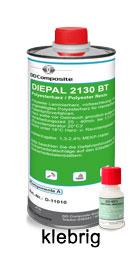
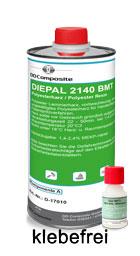
Note:
Both systems do not dry but cure. They therefore require a certain layer thickness, usually between 0.3 and 0.5 mm.
If the layer thickness is too low with a non-sticky system, there is a possibility that this layer will not harden sufficiently and will continue to stick. In this case, you will need to roughen the layer by sanding it before applying another layer.
With sticky systems, additional layers can be applied without prior sanding.
The information contained in these instructions is based on careful research. They are provided for informational purposes only and do not release the user from the responsibility of conducting their own tests for the intended purposes and checking for any infringement of third-party property rights. The information is non-binding and does not constitute a guarantee of properties within the meaning of any laws. No liability is accepted for the accuracy and completeness of the information.