Laminating a panel with polyester resin and fiberglass mat.
With a little craftsmanship, the manufacturing process is not that difficult. A panel should be constructed under optimal conditions, i.e., the material and room temperature should be around 20°C. A dust-free environment and possibly a vacuum cleaner should be available.
Separating layer
Apply Formula Five separating wax sparingly with a cotton cloth and leave to work for 10 minutes. Polish with a clean cotton cloth. Depending on the shape, apply up to five coats, leave to air for a few hours and polish again.
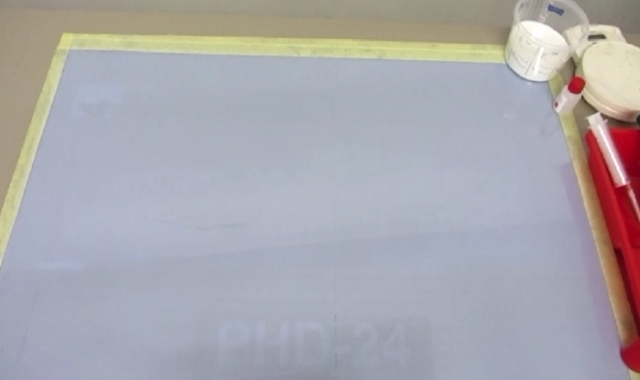
Laminating
You should have all the materials ready and cut or tear the fiberglass mats to size.
To calculate how much gelcoat is needed, you can weigh a piece of fiberglass mat cut to size for the mold.
Example: The cut piece of fiberglass mat 300g/m² weighs 200 grams.
Calculate the surface area: 200g : 300g/m² = 0.67m²
Recommended application quantity of gelcoat 500-850g/m².
Calculate the amount of resin: 850g/m² x 0.67m² = 569.5g
With a hardener addition of 2%, this would be (rounded down): 550g gelcoat and 11g hardener
Stir the gelcoat with the hardener and transfer it to another container. This prevents resin that has not been thoroughly mixed from remaining in the first container at the edges and bottom. Apply the mixture to the glass plate, always stroking in one direction if possible to avoid air pockets. Allow the resin to gel until the surface is still slightly sticky but no longer stringy. It is best to test this with your finger (wear gloves!). To achieve an even surface, it is advisable to apply two coats, allowing the first coat to gel until it passes the finger test.
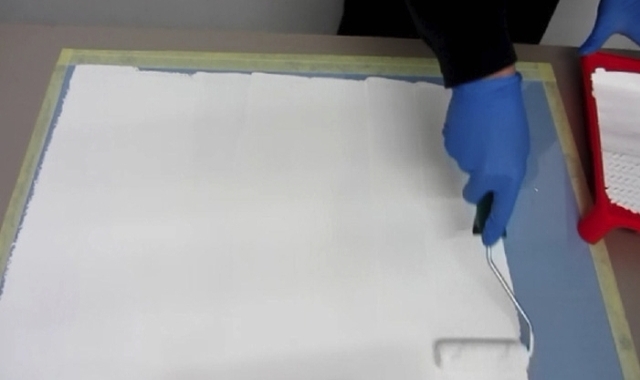
After the second coat has gelled, continue laminating wet on wet! Mix DIEPAL polyester resin with hardener.
For the amount of resin, you can use the rule of thumb: glass weight (total) x 2.5 = amount of resin.
Apply a layer of resin to the mold, lay the first layer of 150 g/m² fiberglass mat and wet the fabric. Use a brush to smooth and dab the air that is still in the laminate from the center to the edge.
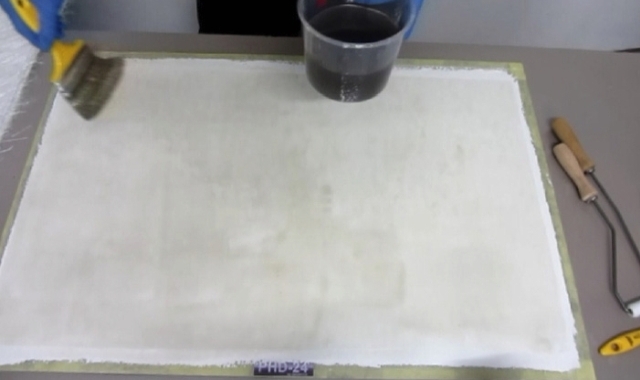
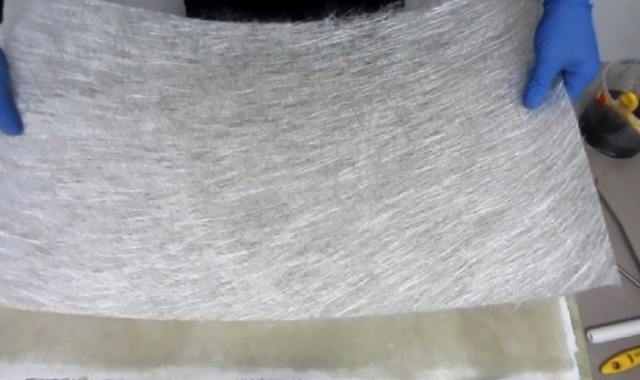
If the fiberglass layer appears transparent, it is optimal; if white spots are visible, some resin should be applied with a brush. Alternatively, a deaerating roller can also be used.
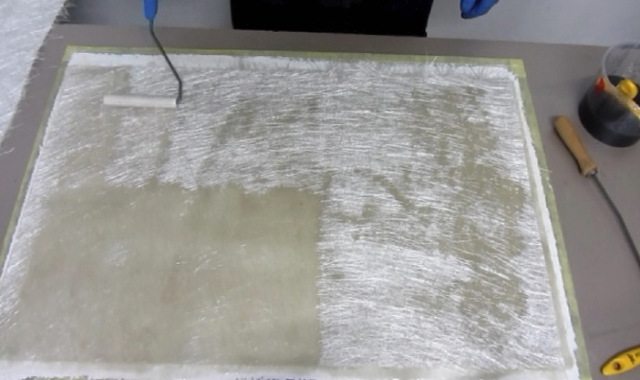
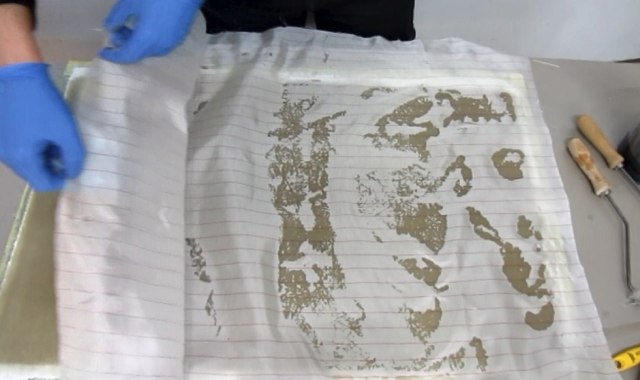
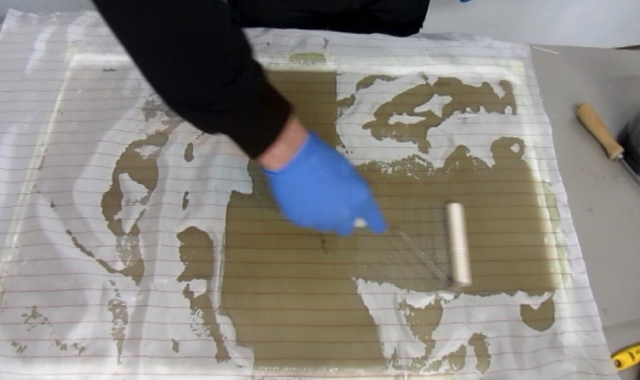
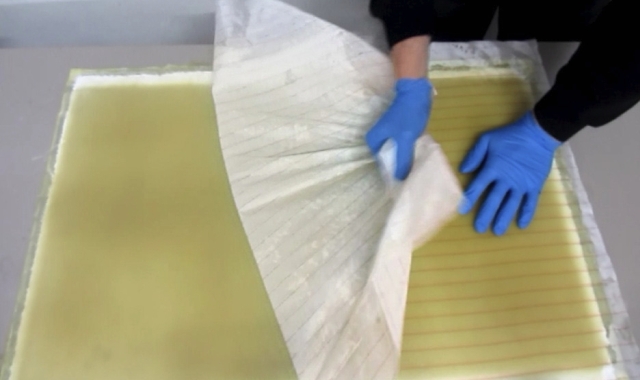
Continue working with a 300 g/m² fiberglass mat and repeat the steps until you reach the penultimate layer. Approximately 4-6 layers of 300g/m² fiberglass mat should be sufficient for a 5 mm thick panel. The number of layers depends on the subsequent requirements for the panel. Alternatively, you can replace 300g/m² fiberglass mats with 450g/m² or 600g/m² mats to achieve a certain material thickness more quickly. To quickly produce thick laminates with high mechanical values, you can also work with complex fabrics, biaxial fabrics, roving fabrics, etc. Always alternate between roving fabrics and fiberglass mats to avoid glass pockets. Fiberglass mats should always be impregnated from the bottom up. Make sure that there is always enough resin on the surface and that the mat is impregnated from the bottom layer after insertion. The last layer should be impregnated with little resin and have a matte sheen after drying. If the surface shines, too much resin has been applied, which you can counteract with a tear-off fabric. After removing the tear-off fabric, the component is completely dust-free, clean, and has an even, rough surface structure. This saves you the hassle of sanding and removing sanding dust.
Demolding
The panel should be left to cure for at least 24 hours at 25°C. The panel should be easy to remove with the aid of plastic or wooden wedges.
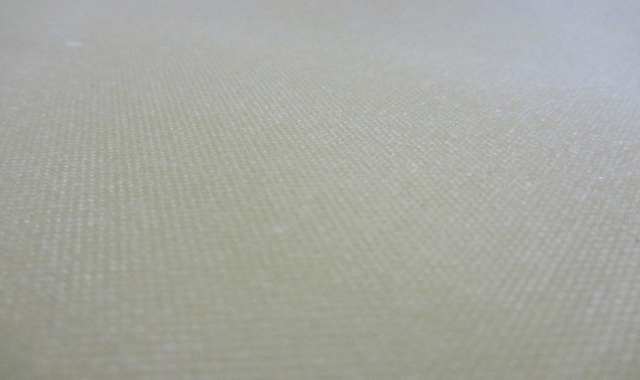
The tear-off fabric leaves behind an even, rough surface structure, providing an ideal base for further laminating, sealing, or gluing.
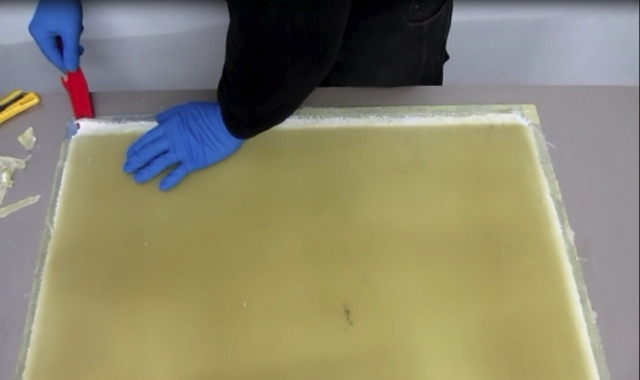
After demolding, you can trim the panel, varnish it if necessary, or polish it to a high gloss. Silicone-free polishing agents should be used for this. Small imperfections in the surface can be filled with a little gel coat and smoothed with a strip of adhesive tape.
Other imperfections can also be repaired with sandpaper (600 to 2000 grit). When sanding and polishing, take care not to generate localized heat.
Instructions in PDF format for downloading or printing can be found here:Laminating a GRP panel
In addition, you can quickly and easily find information about frequently asked questions here. Frequently asked questions
The information contained in this manual is based on careful research. It is provided for informational purposes only and does not exempt the user from conducting their own tests for the intended purposes and from checking for any infringement of third-party property rights. The information is non-binding and does not constitute a guarantee of properties within the meaning of any laws. No liability is accepted for the accuracy and completeness of the information.